
Inside Doniphan Property Tax Records
Two offices split the work behind Doniphan County property tax records. Valuation sits with the Doniphan County Appraiser, who lists real property, assigns its class, and keeps the parcel map current. Collection belongs to the Treasurer, who sends the tax bill, tracks payment status, and handles delinquency questions. The County Clerk holds the tax roll itself. Budgets and Revenue Neutral Rate material also come from the Clerk's office. Those fiscal papers can show districts and broad trends, though they never state what a single parcel owes.
| Tax record field | Question it answers | Official source |
|---|---|---|
| Appraised value | What full value the mass-appraisal process assigns | County Appraiser |
| Classification | Which Kansas property class and ratio apply | County Appraiser |
| Assessed value | The value to which the mill levy is applied | County Appraiser |
| Tax statement and status | What is billed, paid, or delinquent | County Treasurer |
| Taxing districts | Which local units contribute to the levy | Tax roll and county fiscal records |
A tax file mixes several numbers that mean different things. A deed records a conveyance. An appraised value is the Appraiser's estimate for the tax system, and Kansas applies a class ratio to it before the levy sets the actual tax. Payment activity lives with the Treasurer. Keeping these sources straight matters. A paid bill is not proof of title, and an assessed value is not a sale price.
Doniphan Tax Offices Split Duties
The Appraiser and the Treasurer each handle a different slice of a Doniphan County property tax search. The Appraiser, at 785-985-3977, covers parcel cards, classification, valuation data, maps, and questions about comparable sales. That office sits at 120 E Chestnut Street, PO Box 427, Troy, Kansas 66087, and accepts email at appraiser@dpcountyks.com. Include the address, the Quick Ref ID, or the full parcel number so staff can pull the right tract.
The County Treasurer is the office for current statements, prior payment records, delinquency status, payment-under-protest questions, and tax-sale standing. The county publishes no public Doniphan tax-bill interface. Without one, the courthouse, the phone, and a focused records request carry the load. The main county number is 785-985-3513, and the Treasurer notes that title work stops after 4:30 p.m.
The County Clerk offers another route when you need a copy of an existing roll entry or fiscal record. KORA does not oblige staff to build a new calculation. It does back a request for an existing parcel entry, notice, statement, or district document.
Doniphan Property Tax Calendar
The county property-tax calendar runs as a sequence, not a single deadline. Classification and valuation work comes first. A notice follows, giving the owner a defined window to question the value. Taxes come due and payable November 1. The first half is due December 20 without penalty. The second half is due May 10 of the next year, subject to the county's stated exceptions.
- Match the notice to the parcel number, legal description, class, and tax year.
- Contact the Appraiser within 30 days of the notice when disputing classification or valuation.
- Obtain the actual tax statement and payment history from the Treasurer.
- Keep receipts and any payment-under-protest filing with the parcel research log.
The notice date does a lot of work here. It opens the local appeal window. A bill date cannot replace it. An owner in Doniphan County who sits tight until the payment deadline risks losing the earlier valuation-review route and may have to fall back on the payment-under-protest procedure instead. For the current sequence of dates, the official Doniphan County property-tax calendar is the place to look.
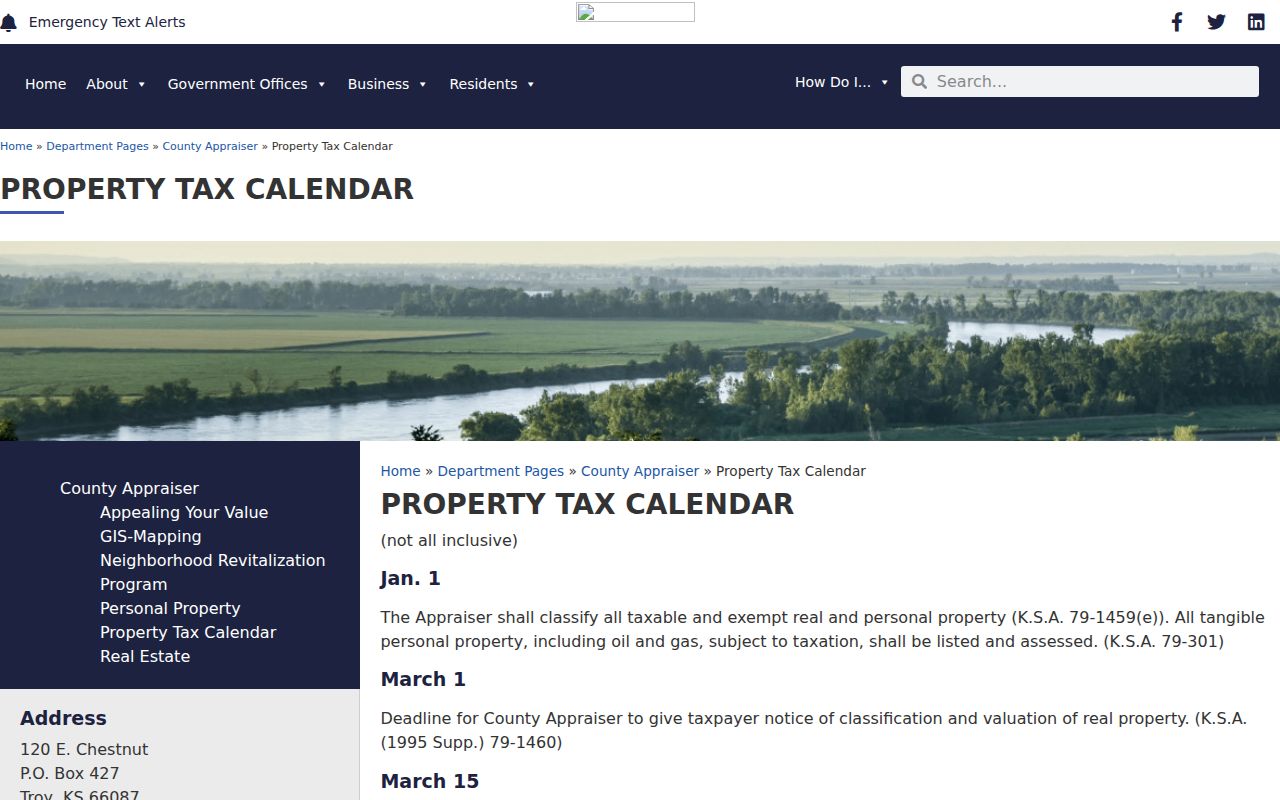
The county's tax calendar lays out the assessment notice, protest stage, and payment dates in their official order.
How Doniphan Assessment Math Works
Kansas draws a line between appraised value and assessed value. Under the Property Valuation Division formula, appraised value approximates fair market value. It gets multiplied by an assessment ratio to yield assessed value. Multiply that figure by the mill levy and you have the property tax. The ratio depends on the property's class. Two Doniphan County parcels with nearly identical appraised values can carry very different assessed amounts if their legal classifications differ.
- Appraised value
- The county's mass-appraisal estimate under the method that applies to the property.
- Assessed value
- The ratio-adjusted amount used in the tax calculation.
- Mill levy
- The combined tax rate from the taxing districts attached to the parcel.
- Tax lien
- A claim tied to unpaid tax that must be confirmed through the Treasurer and recorded or court sources.
For real property, the Doniphan County Appraiser relies on cost, income, and comparable-sales approaches. The result is countywide mass appraisal. That is not a private appraisal tied to one transaction, and it does not promise what a buyer will actually pay for the parcel.
Doniphan Agricultural Value Uses Another Track
Farmland gets valued on its own track in Doniphan County. Instead of chasing market sales, the ag formula spreads income over eight years. It folds in commodity prices, yields, and landlord expenses. Then it applies a capitalization rate drawn from local data and Property Valuation Department figures. Soil maps and agricultural-use layers in IntegrityGIS add useful context. A map layer by itself never assigns the class or the value, though.
Start with the Appraiser's office. Ask which property class the parcel record carries and which fields feed the calculation. Then check the answer against the official Kansas assessment rates. One caution applies here. A rural parcel can mix farmland with improvements, and the two need separate reading. Never treat an agricultural use value as a guess at the tract's sale price.
Note: The eight-year method values agricultural use. It does not guess what the land would fetch on the open market.
Look Up Doniphan Tax Status
Doniphan County publishes no single Treasurer search form for tax bills. So the dependable workflow starts with the parcel number. Use IntegrityGIS to locate the tract first. Then the Appraiser confirms the parcel's value and classification. From there, the Treasurer can pull the current tax bill and its payment status. It takes a few steps, but keeping valuation, billing, and title questions with their proper offices prevents confusion.
- Find the tract in Doniphan IntegrityGIS and record its Quick Ref ID or full parcel number.
- Request the parcel card, class, appraised value, assessed value, and applicable year from the Appraiser.
- Give the same identifier to the Treasurer and request the statement, payment history, and current delinquency status.
- If an existing record is still unavailable, send a narrow KORA request naming the parcel, tax year, record, and desired format.
The county's own Treasurer page is the right online starting point. Open the Doniphan County Treasurer page, then contact the office for any parcel-specific balance.
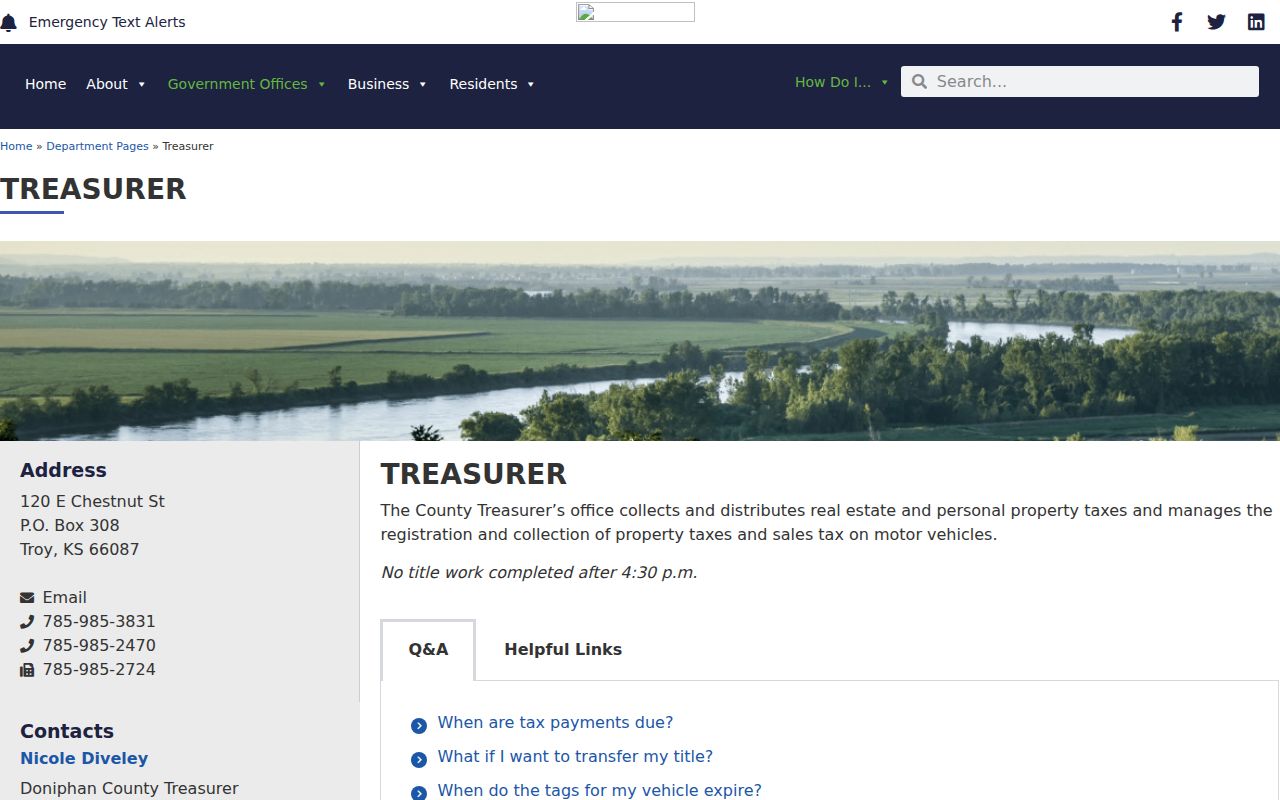
That page confirms which office keeps the records. A current tax amount still has to come straight from the Treasurer.
Contest a Doniphan Tax Assessment
An appeal fights the classification or valuation itself. It is not simply a protest that a bill came due. Doniphan County asks owners to contact the Appraiser within 30 days of the notice. Strong support includes the parcel card and a corrected property description. Add documented condition facts and comparable sales too. Ask which form and evidence apply before you file. The county's valuation appeal FAQ also names payment under protest as a separate route. That path ties the payment to the challenge itself. Talk with the county well before the due date. Want to dig into the value figures without touching the bill? See the Doniphan County property value record.
Protect the deadline. Contact the Appraiser within 30 days of the valuation notice and confirm the current form and filing method.
The county's valuation appeal instructions provide the official local route.
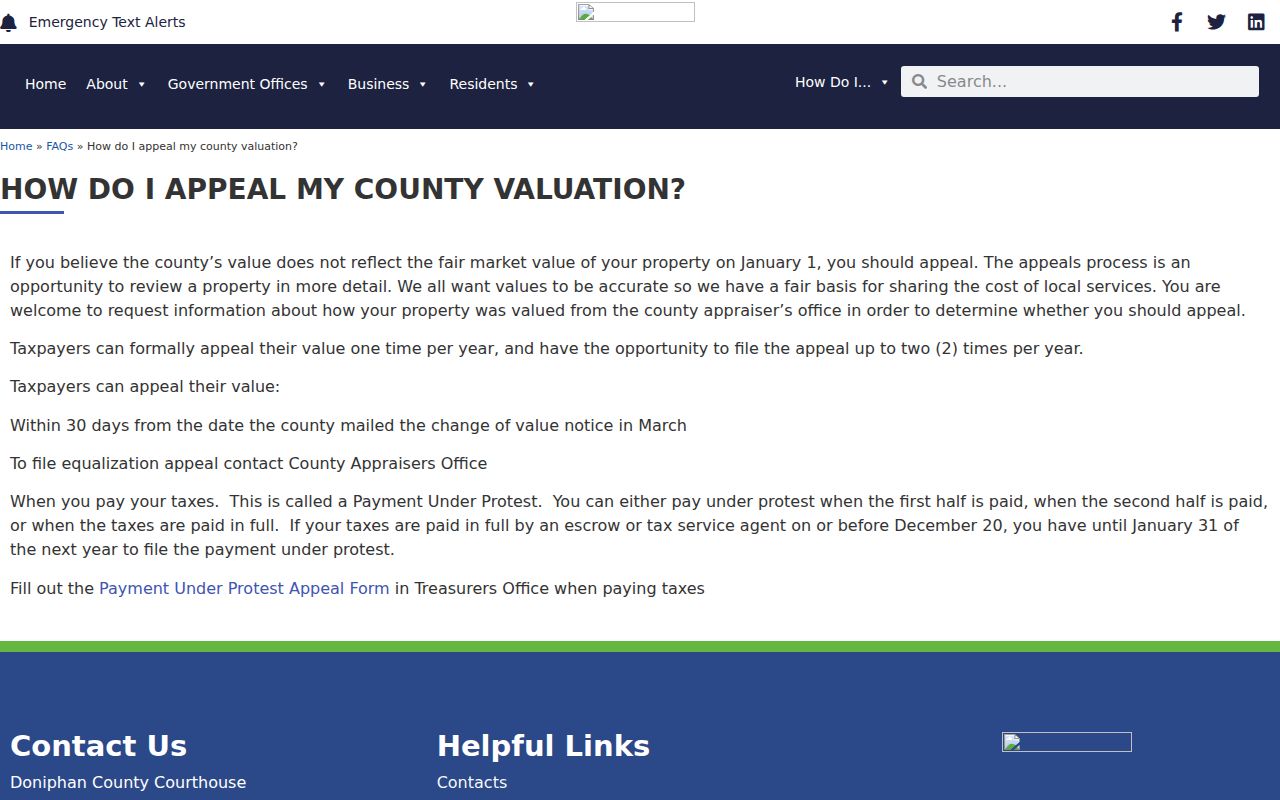
The county page shows both appeal routes as distinct choices.
Doniphan Delinquency Needs Confirmation
A missed deadline can trigger penalties and delinquency. The county publishes no public delinquent-tax list or auction interface. Never assume a tax sale from an old balance. Never assume one from a court caption or a third-party listing either. Ask the Treasurer directly whether the parcel is current, delinquent, or under a payment arrangement. Ask whether it is headed to sale. Write down the date of that answer. If litigation exists, the Doniphan County District Court may hold a tax file. It may hold a foreclosure or confirmation file instead. The court record shows what happened and how it ended. Any resulting deed or lien release belongs with the Register of Deeds. Check each source. A petition alone does not prove a sale. Paying a tax bill does not establish ownership. Note: Give the parcel number and tax year with every inquiry so staff never mix up similar owner names or neighboring tracts.
Recent Doniphan Value Studies
The Appraiser page links official 2025 and 2026 Market Study Analysis documents. These show how the county weighs market evidence countywide. They do not prove a trend for one city, neighborhood, or parcel unless the document says so. A sound property tax records check pairs the dated study with the actual parcel card and notice. The County Clerk also posts Revenue Neutral Rate summaries, district notices, and budget material. That levy context helps explain why bills shift. It never replaces the Treasurer's actual tax bill. For a purchase, appeal, or estate file, keep the study date, parcel-record year, notice, statement, and payment confirmation as separate records.